

Echo Frontier: patching AI-Found Zero-Days before disclosure

Two months ahead of the patch: why we built Echo frontier
Frontier AI models from Anthropic, OpenAI, Google and xAI are now finding vulnerabilities in open source software faster than maintainers, scanners and the CVE system can respond. Some of those findings will be zero-days in the libraries and images you run in production, with no CVE, no scanner alert and no upstream fix.
Echo makes you ready for that moment. We run the frontier labs' own cyber models against the open source software you depend on, patch what they find, and deliver the fix to you before the vulnerability goes public. Underneath that, Echo gives you hardened, continuously patched containers, libraries, OS packages and VMs, so the known CVEs are handled too.
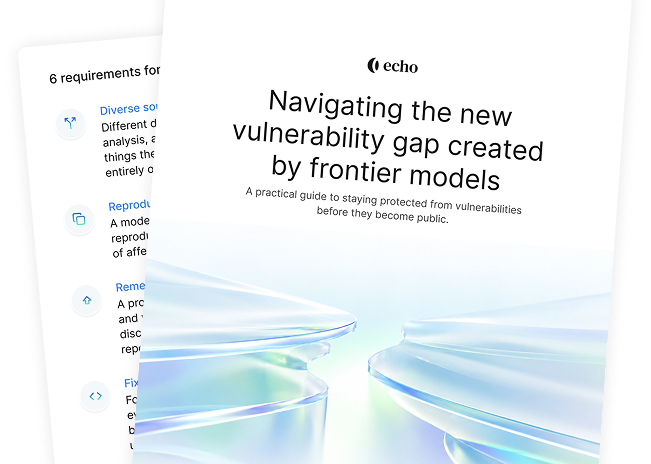
Want the full playbook? Download the report: How to prepare for the Frontier Labs vuln findings.
Key takeaways
- Frontier AI is finding zero-days at scale. Anthropic, OpenAI, Google and xAI all now run cyber-capable models, and an open-weight model, GLM-5.3, just matched them closely on exploit development.
- The CVE is no longer the starting line. A flaw can be found and weaponized before there is a CVE, a scanner detection or an upstream patch.
- Echo finds them first with the same models. Echo uses frontier lab models, including Mythos, GPT-5.6-Cyber and Grok, to hunt for unknown flaws in the open source you run.
- Echo patches them before disclosure. Fixes are validated, backported to your versions and delivered through JFrog or Nexus before the vulnerability is public.
- Echo covers the known CVEs too. Hardened containers, libraries, OS packages and VMs are continuously patched, so your whole software supply chain is ready.
{{cta_frontier}}
A bug in OpenEXR, and a two-month head start
Not long ago, our security research team found something nobody else had found yet. Inside OpenEXR, the open source image file format library widely used across visual effects and image-processing software, there was a high-severity denial-of-service vulnerability. No CVE. No advisory. No scanner rule. As far as the rest of the world was concerned, the bug did not exist.
In the old world, that would have been the start of a long wait. The maintainers would be notified, a fix would eventually land upstream, a CVE would be published, scanners would light up, and only then would enterprise security teams start their clock.
That is not what happened. Within about two days, Echo had reproduced the flaw, developed a patch, tested it for compatibility and delivered it to customers. The upstream fix arrived around two months later. For those two months, our customers were running software that was already safe against a vulnerability most of the industry could not yet see.
That gap, between the moment a flaw is discovered and the moment the ecosystem catches up, is exactly where the next wave of attacks will live. It is why we built Echo Frontier, which is now generally available.
The sequence enterprise security was built on
For decades, vulnerability management has followed a reassuringly orderly script: discover → disclose → CVE → fix → enterprise remediation. Scanners match against published CVEs. Patch pipelines wait for maintainers. SLAs start counting at disclosure. Everything downstream assumes the defender learns about a flaw at roughly the same time as the attacker.
That script already had cracks. Backlogs grew faster than teams could clear them, and severity scores were a shaky guide to real risk. But it held together because finding new vulnerabilities was slow, expensive and done by a relatively small number of skilled people.
Frontier AI removed that constraint. As we covered in Claude Mythos, Explained: What the Benchmarks Show, the durable change is not one headline benchmark but the cost of discovery collapsing. When finding a flaw gets cheap, the assumption that disclosure comes first stops being true.
What changed on September 29
Until recently, the most capable cyber models sat behind vetted-access programs, with guardrails designed to keep the sharpest capability in defenders' hands. On September 29, 2026, Anthropic published research showing how thin that line has become.
Zhipu AI's open-weight GLM-5.3 developed working end-to-end exploits in 50 of 410 attempts on the ExploitBench benchmark. Claude Mythos Preview managed 56. The difference is not the score. It is who gets to use it: unlike Mythos Preview, GLM-5.3 can be downloaded by anyone. Anthropic called the release "a meaningful step change in the cyber capabilities available to attackers."
"AI models are completely rewriting the vulnerability lifecycle," said Eilon Elhadad, Echo's co-founder and CEO. "The old assumption was that a vulnerability becomes public, gets a CVE and a fix, and then enterprises respond, but that sequence no longer holds. If AI can find vulnerabilities before the traditional security ecosystem is able to, remediation has to move earlier as well."
For a CISO, this is no longer a research curiosity. It is a material business risk. Once you know a vulnerability exists in software you run, you need a reliable way to act on it, even when the rest of the ecosystem has not caught up.
Finding the flaw was never the hard part
Here is the uncomfortable truth behind the AI discovery boom: a finding does not make anyone safer on its own. Someone still has to reproduce it, work out which versions are affected, write a fix that actually closes the hole without breaking the application, and get that fix into production.
It is tempting to ask another model to write the patch. The data says that is not enough. Research from 1Password's Off-by-1 Labs found that 54% of 6,080 AI-generated patches either failed to fix the vulnerability, introduced a new one, or both. Even the findings themselves need scrutiny: when Anthropic's Mythos disclosures were independently re-scored, 14 of the 27 CVEs carried a severity mismatch.
Security leaders feel this already. In Echo's Mythos Readiness Report, 37% of US security leaders named "detecting more than we can fix" as their biggest obstacle, while only 11% would invest next in more detection. More discovery without reliable fixes just makes the queue longer.
"Frontier AI can now uncover zero-day CVEs, but without the means to fix them, every discovery becomes another liability," said Eylam Milner, Echo's co-founder and CTO. "We built Echo Frontier around the harder question: once a previously unknown vulnerability is found, how quickly can we turn it into software that is actually safe for an enterprise to run?"
How Echo Frontier turns a discovery into a deployable fix
Echo Frontier sits on top of the infrastructure Echo already runs to vet, patch, rebuild and deliver open source software across containers, libraries, OS packages and VMs. What changes is where the process starts. Instead of waiting for disclosure, it starts at discovery. Go back to the OpenEXR bug and follow it through:
- Discover: model-driven analysis and human-led security research hunt for unknown flaws in the open source our customers depend on.
- Validate: each finding is reproduced against a working proof of concept, and affected versions are mapped.
- Notify: Echo alerts the maintainers and handles coordinated vulnerability disclosure as an authorized CVE Numbering Authority (CNA).
- Patch and test: Echo develops the fix and backports it where needed, validating it against the exploit and compatibility-testing it through the full application in a cloud environment.
- Deliver: patched software arrives privately through the customer's existing JFrog or Nexus infrastructure.
- Converge: once the official upstream fix ships, customers move onto it, so nobody is left on a permanent fork.
The result is a reordered lifecycle: discover → validate → fix → protect → disclose → converge upstream. Protection comes before disclosure, not months after it.
Two details matter more than they first appear. Because every fix is compatibility-tested through the full application, teams can deploy it without the usual fear of breaking behavior in production. And because customers receive an evidence trail documenting detection and remediation, the work stands up in an audit, not just in a changelog.
What this means for your security team
For most organizations, zero-day attack prevention has meant detection and containment: watch for strange behavior, limit blast radius, wait for a patch. Echo Frontier adds something that was not previously on the menu, which is a tested fix for a flaw before the world knows it exists.
That shifts vulnerability remediation from a reactive scramble to a planned delivery. Your scanners and SLAs still matter for the known CVEs, and Echo continues to cover those with hardened, continuously patched software. Frontier handles the part of the timeline that used to be empty: the weeks or months between discovery and disclosure.
The questions worth asking your team now are simple. If a frontier model found a flaw in a library you run tomorrow, who would tell you? Who would write the fix? And how long would you be exposed while you waited?
Get the full guide
This post covers why we built Echo Frontier. The full guide goes deeper into why the CVE is no longer the starting line, the six requirements for pre-disclosure protection, and how to get patched before a vulnerability goes public.
Download the full guide: How to prepare for the Frontier Labs vuln findings
FAQ
What is Echo Frontier?
Echo Frontier is an Echo offering that protects organizations from zero-days uncovered by frontier AI models before those vulnerabilities are publicly disclosed. Echo finds and validates unknown flaws in open source software, develops and compatibility-tests a patch, and privately delivers it through existing JFrog or Nexus infrastructure. Once the official upstream fix is available, customers converge back to it. Echo Frontier is generally available now.
Why can't we just wait for a CVE?
Because the CVE now arrives after the risk does. Frontier AI models, including open-weight models anyone can download, can find and exploit unknown flaws before a CVE, scanner detection or upstream patch exists. Waiting for disclosure means running vulnerable software through the most dangerous window, when attackers may already know about a flaw and your tools cannot see it yet.
Aren't AI-generated patches good enough?
Not on their own. Research from 1Password's Off-by-1 Labs found that 54% of 6,080 AI-generated patches failed to fix the vulnerability, introduced a new one, or both. Echo Frontier validates every fix against the exploit and compatibility-tests it through the full application in a cloud environment, so teams can deploy it without breaking application behavior in production.
How does Echo Frontier handle disclosure?
Echo is an authorized CVE Numbering Authority (CNA). When Echo Frontier validates a new vulnerability, Echo notifies the open source maintainers and coordinates the disclosure timeline with them. Customers are protected privately in the meantime, and once the upstream fix ships, Echo moves them onto the official release so they are never left depending on a long-term fork.
How does Echo Frontier support compliance?
Every customer receives an evidence trail documenting how each vulnerability was detected and remediated, from validation through patch testing and delivery. That record helps security and compliance teams show auditors that previously unknown risks were identified and addressed on a defined process, even when no public CVE or advisory existed at the time the fix was applied.
Frontier models can now find and exploit zero days in your code
Find out what to do when there's no CVE, scanner alert or fix available yet.
What are the 7 blind spots in your vulnerability scans?
Discover when "0 vulnerabilities" doesn't actually mean you're clean.
Read the report
Read the report
.avif)
.avif)