

Zero-Day Vulnerability Protection for Frontier AI | Echo


Zero-Day Vulnerability Protection for the Frontier AI Era: How Echo Gets You Patched Before Disclosure
Frontier AI models from Anthropic, OpenAI, Google and xAI are now finding vulnerabilities in open source software faster than maintainers, scanners and the CVE system can respond. Some of those findings will be zero-days in the libraries and images you run in production, with no CVE, no scanner alert and no upstream fix.
Echo makes you ready for that moment. We run the frontier labs' own cyber models against the open source software you depend on, patch what they find, and deliver the fix to you before the vulnerability goes public. Underneath that, Echo gives you hardened, continuously patched containers, libraries, OS packages and VMs, so the known CVEs are handled too.
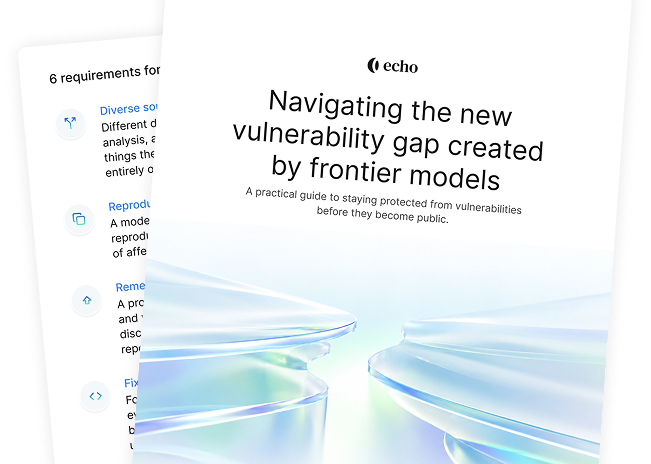
Want the full playbook? Download the report: How to prepare for the Frontier Labs vuln findings.
Key takeaways
- Frontier AI is finding zero-days at scale. Anthropic, OpenAI, Google and xAI all now run cyber-capable models, and an open-weight model, GLM-5.3, just matched them closely on exploit development.
- The CVE is no longer the starting line. A flaw can be found and weaponized before there is a CVE, a scanner detection or an upstream patch.
- Echo finds them first with the same models. Echo uses frontier lab models, including Mythos, GPT-5.6-Cyber and Grok, to hunt for unknown flaws in the open source you run.
- Echo patches them before disclosure. Fixes are validated, backported to your versions and delivered through JFrog or Nexus before the vulnerability is public.
- Echo covers the known CVEs too. Hardened containers, libraries, OS packages and VMs are continuously patched, so your whole software supply chain is ready.
{{cta_frontier}}
What Echo offers to get you ready for frontier AI vulnerability findings
Being "frontier-ready" takes more than one tool. Here is everything Echo provides, and how each piece helps:
- Echo Frontier: zero-day discovery and patching. Echo runs frontier lab cyber models against the open source packages you use, validates every finding, develops and backports a patch, and privately delivers it before public disclosure.
- Coordinated disclosure as a CNA. As an authorized CVE Numbering Authority, Echo notifies maintainers, assigns CVEs and manages disclosure timelines for what it finds.
- Delivery into your existing pipeline. Patched software arrives through the tools you already use, including JFrog and Nexus, so there is no new registry to adopt.
- Hardened software for every layer. Echo Containers, Libraries, OS Packages, VMs, Serverless and Helm charts are built secure by default and continuously patched against known CVEs.
- Patch SLAs for known vulnerabilities. Echo commits to a 7-day SLA for critical and high CVEs, with an average time to remediate of under 12 hours.
- EOL support. Images you can no longer upgrade keep getting fixes, which matters when a frontier model finds a flaw in an old version.
- Convergence back upstream. Once the official fix ships, Echo moves you onto it, so you never depend on a permanent proprietary fork.
The rest of this post explains why this matters now, and how Echo Frontier turns a frontier AI finding into a patch you can deploy.
Why frontier AI findings break the traditional vulnerability lifecycle
Every major frontier lab now has a cyber-capable model, and most keep it behind a vetted-access program:
- Anthropic: Claude Mythos Preview, shared with defenders through Project Glasswing, which found more than 10,000 vulnerabilities in critical software. We covered it in Supply chain attacks, Mythos, Glasswing... and Echo.
- OpenAI: GPT-5.6-Cyber, available to approved defenders through its Daybreak program.
- Google DeepMind: Gemini 3.5 Flash Cyber, a limited-access model built to find, verify and patch vulnerabilities.
- xAI: invite-only access to Grok 4.7's red-team capabilities for select security partners.
Those programs were designed to keep the most dangerous capability with defenders. That line is now blurring. On September 29, 2026, Anthropic published research on GLM-5.3, an open-weight model from Zhipu AI that anyone can download:
- Near-frontier exploit development: GLM-5.3 built successful end-to-end exploits in 50 of 410 ExploitBench attempts, compared with 56 of 410 for Mythos Preview.
- Real zero-days: in researcher-led testing, it found previously unknown flaws in a popular web browser's JavaScript engine and chained them into a working zero-day exploit.
- Weak safeguards: simple deceptive prompts bypassed its protections 64% of the time.
Anthropic calls the release "a meaningful step change in the cyber capabilities available to attackers."
That breaks the sequence enterprise security was built on:
Discover → disclose → CVE or advisory → upstream fix → enterprise remediation
Scanners match against published CVEs. Patch pipelines wait for maintainers. SLAs start counting at disclosure. That system already has gaps, from CVEs that vanish in upstream bug trackers to clean scans that miss real risk, and enterprise vulnerability remediation still largely begins after disclosure. When a frontier model surfaces a zero-day vulnerability, none of that infrastructure exists yet:
- No CVE or advisory to track
- No scanner detection to alert on
- No upstream patch to apply
- No established path from finding to production
The CVE can no longer be treated as the starting line for remediation.
Finding a zero-day is only half the problem
A frontier AI finding does not make anyone safer on its own. Someone still has to reproduce it, map the affected versions, write a patch that stops the exploit without breaking application behavior, backport it, and ship it safely.
Asking another model to write the fix is not enough. In August 2026, 1Password's Off-by-1 Labs evaluated 6,080 AI-generated patches across six open source vulnerabilities. Only 26% fully fixed the flaw without materially changing behavior, and 53.9% failed to fix it, introduced a new vulnerability, or both.
Security leaders already feel this. In Echo's Mythos Readiness Report, 37% of US security leaders said "detecting more than we can fix" is their biggest obstacle, while only 11% would invest in more detection. More findings without reliable fixes just grow the queue, a pattern we unpacked in Why CVE backlogs keep growing.
How Echo Frontier turns a frontier AI finding into a fix
Echo Frontier connects the two halves of the problem: frontier-model discovery and production-safe remediation.
The process runs in seven steps:
- Discover: Echo runs frontier lab cyber models, including Claude Mythos, GPT-5.6-Cyber and Grok, against the open source packages its customers depend on.
- Validate: Echo's security researchers reproduce each finding against a working proof of concept and map the affected versions.
- Notify: Echo notifies the open source maintainer and coordinates disclosure as an authorized CNA.
- Patch: when no upstream fix exists, Echo develops and validates one, backporting it to the versions customers already run.
- Deliver: patched software reaches customers through JFrog or Nexus within the coordinated disclosure timeline.
- Disclose: the vulnerability is made public on the timeline agreed with the maintainer.
- Converge: once the official upstream fix is available, Echo moves customers back to it.
The result reverses the sequence:
Discover → validate → fix → protect → disclose → converge upstream
By the time a vulnerability becomes public, affected Echo Frontier customers can already be patched. Echo Frontier runs on the same infrastructure Echo already operates every day to vet, patch, rebuild and deliver open source software, including automated remediation and patch SLAs for known vulnerabilities.
How to get ready for frontier AI vulnerability findings
Frontier AI findings are coming whether or not your team is ready. Practical steps to take now:
- Assume unknown flaws are discoverable. Plan for adversaries who find bugs in your dependencies before maintainers do.
- Measure time-to-protected, not time-to-CVE. Track how long it takes to get a validated fix into production from the moment a flaw exists.
- Treat AI-generated patches as drafts. Require proof-of-concept validation and behavior testing before anything ships.
- Insist on backports. A fix that only lands in the newest major version does not protect the versions you actually run.
- Make open source vulnerability management a pre-disclosure discipline. Know which packages you depend on and who can patch them before a CVE exists.
Get the full playbook. Download the report: How to prepare for the Frontier Labs vuln findings. It covers why the CVE is no longer the starting line, the 6 requirements for pre-disclosure protection, and how to get patched before a vulnerability goes public.
FAQ
What is Echo Frontier?
Echo Frontier is Echo's service for vulnerabilities that do not have a CVE yet. Echo runs frontier lab cyber models against the open source software customers depend on, validates each finding against a working proof of concept, develops and backports a patch, and privately delivers the fix before public disclosure. It extends Echo's existing protection against known vulnerabilities and supply chain threats to what frontier models uncover next.
Which frontier AI models does Echo use to find vulnerabilities?
Echo uses the frontier labs' own cyber-capable models, including Anthropic's Mythos, OpenAI's GPT-5.6-Cyber and xAI's Grok, to hunt for unknown vulnerabilities in the open source packages its customers run. Using the same class of models attackers are starting to access means Echo can surface those flaws first. Every model finding is then reproduced and validated by Echo's security researchers before any patch work begins.
What else does Echo offer besides Echo Frontier?
Echo delivers hardened, continuously patched software across the supply chain: container images, libraries, OS packages, VMs, serverless runtimes and Helm charts, plus EOL support for images you cannot upgrade. Known critical and high CVEs are covered by a 7-day SLA, with average remediation under 12 hours. Echo Frontier adds protection for zero-days found by frontier AI before they are public.
How is Echo Frontier different from a vulnerability scanner?
Scanners match your software against vulnerabilities that are already public, so they cannot alert on a flaw that has no CVE. Echo Frontier works earlier in the chain. It finds the vulnerability, confirms it is real, builds and tests a fix, and delivers patched software to you. The output is not another alert in a queue but a validated update you can deploy before the issue is public.
How are Echo Frontier patches validated?
When no upstream fix exists, Echo develops a patch and tests it against the proof of concept to confirm the exploit no longer works, while checking that application behavior is preserved. This matters because research from 1Password found most AI-generated patches either failed to fix the flaw, introduced a new one, or changed how the software behaves. Echo then backports the validated patch to the versions customers run.
How do Echo Frontier patches reach my environment?
Patched software is delivered through the infrastructure you already use, including JFrog and Nexus, so there is no new pipeline to build. Delivery happens within the coordinated disclosure timeline agreed with the maintainer. Your teams roll out the fix through normal artifact and deployment workflows and are protected by the time the vulnerability becomes public, rather than starting remediation on disclosure day.
Does Echo Frontier follow responsible disclosure?
Yes. Echo notifies the open source maintainer of every vulnerability it finds and coordinates disclosure through its role as an authorized CVE Numbering Authority (CNA). Customer protection happens inside the agreed disclosure window, and the vulnerability is published on the timeline set with the maintainer. Once the official upstream fix is released, Echo converges customers back to it rather than leaving them on a proprietary fork.
How can my team prepare for frontier AI vulnerability findings?
Start with Echo's report, How to prepare for the Frontier Labs vuln findings. It explains why the CVE is no longer the starting line, lays out the 6 requirements for pre-disclosure protection, and shows how organizations can get patched before a vulnerability goes public. Download the full report, or explore Echo Frontier to see how it works.
Frontier models can now find and exploit zero days in your code
Find out what to do when there's no CVE, scanner alert or fix available yet.
What are the 7 blind spots in your vulnerability scans?
Discover when "0 vulnerabilities" doesn't actually mean you're clean.
Read the report
Read the report
.avif)
.avif)